One-sentence answer: Fragrance concentration is simply how much perfume oil is dissolved in the alcohol-and-water base — from roughly 20–40% in a parfum down to 1–3% in a body mist — and that single number drives almost everything you notice: how rich a scent smells, how far it projects, how long it lasts, and what it costs. The catch: these terms aren’t legally defined, so the actual formula matters more than the letters on the bottle.
What fragrance concentration actually means
Every fragrance is mostly a carrier — denatured alcohol, usually with a little water — with a percentage of aromatic oils dissolved into it. That percentage is the concentration. A parfum is dense with oil and light on alcohol; a body mist is the reverse. Everything from Chanel to a drugstore body spray sits somewhere on that ladder.
Here’s the part most guides bury: there is no legal or industry standard that defines these names. No regulator says an Eau de Parfum must contain 15% oil. Each house draws its own line, which is exactly why one article swears EDP is 15–20% while another starts it at 12% or pushes it past 25%. They’re all quoting different brands. Treat every percentage below — including ours — as a useful convention, not a rule.
The fragrance concentration chart
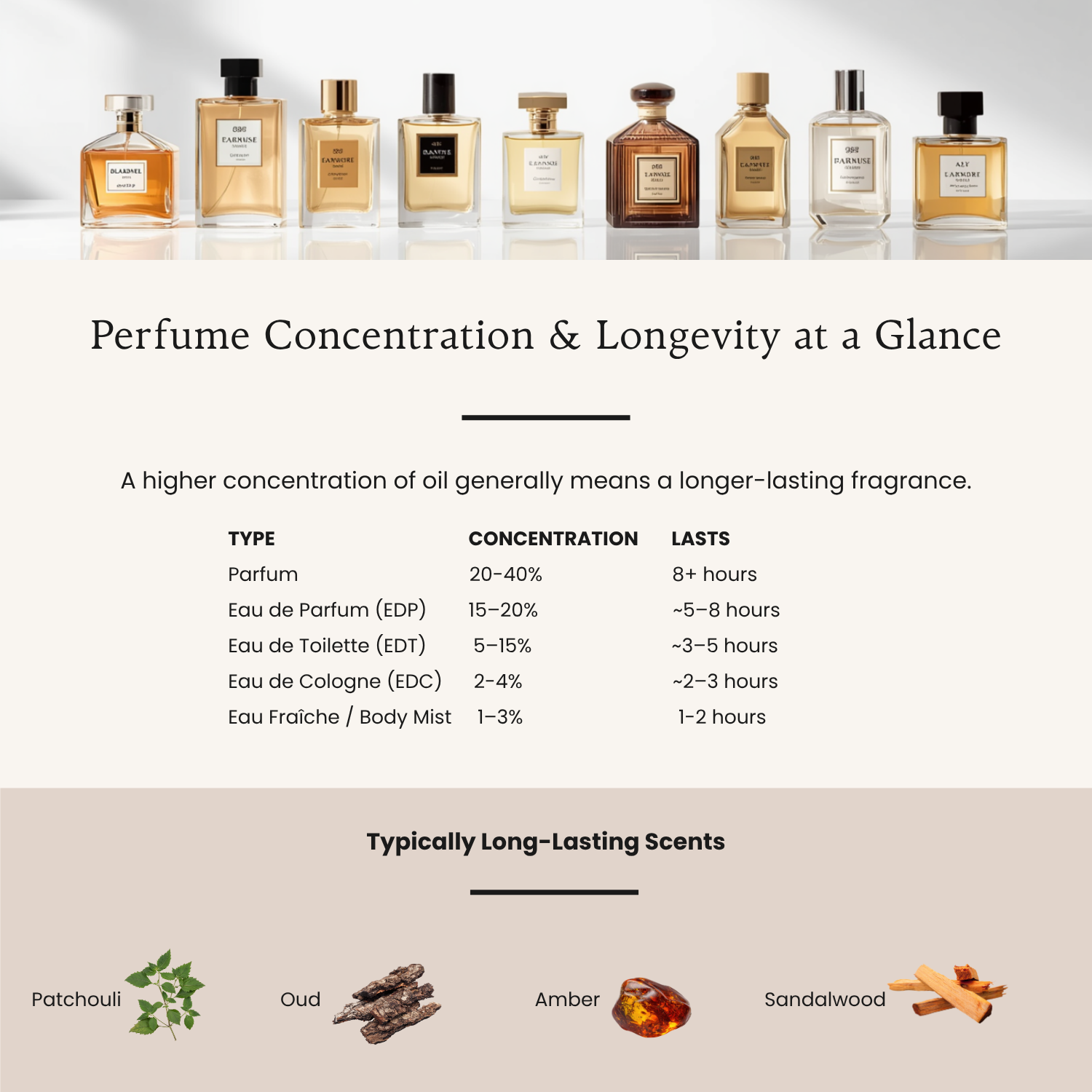
Strongest to lightest, here’s how the main formats compare. Concentration sets the ceiling; the specific composition decides where a fragrance actually lands within it.
| Concentration | Oil content | Typical longevity | Projection | Best for |
|---|---|---|---|---|
| Parfum / Extrait | ~20–40% | 8+ hours, often all day | Rich but sits closer to skin | Occasions, cold weather, signature scents |
| Eau de Parfum (EDP) | ~15–20% | ~5–8 hours | Strong, noticeable trail | Evenings, dates, everyday if you love it |
| Eau de Toilette (EDT) | ~5–15% | ~3–5 hours | Bright and diffusive early, then softens | Office, gym, hot days, layering |
| Eau de Cologne (EDC) | ~2–4% | ~2–3 hours | Light, fresh, quick | Humid climates, a quick reset |
| Eau Fraîche | ~1–3% | ~1–2 hours | Very light | Post-gym freshness, hot weather |
| Body mist / fragrance mist | ~1–3% | ~1–2 hours | Soft, close | Casual refresh, layering, spraying freely |
Each concentration, briefly
Parfum (also called extrait or pure perfume) is the richest everyday format, generally 20–30% oil, and some go higher. It’s dense, warm and long-lasting — often still faintly there the next morning on a scarf. Because it’s so concentrated, you dab or use one or two sprays rather than dousing yourself, and it sits at the top of the price range.
Eau de Parfum is the modern default for a serious fragrance: enough oil for real depth and staying power, without the pinpoint restraint a parfum demands. Two or three sprays usually carry a day, which is why most designer and niche houses lead with it.
Eau de Toilette carries more alcohol and less oil, so it feels brighter on application and settles faster. That lightness is a feature, not a flaw — it makes EDT the smart pick in heat, in close quarters, and for spraying freely.
Eau de Cologne is the classic light, citrus-forward splash in the traditional 4711 style, low on oil and built to refresh rather than last. Note that in the US, cologne is also used loosely to mean any men’s fragrance, which is a marketing label rather than a concentration.
Eau Fraîche and body mists sit at the bottom of the ladder — mostly water or alcohol with a whisper of oil. They’re made to be sprayed liberally and reapplied, which is exactly how you should use them. A close cousin is hair perfume (or hair mist) — a lightly concentrated, low-alcohol format made to scent your hair without drying it out.
Elixir, Parfum Intense and other “extra-strength” names
Beyond the standard ladder, brands increasingly use names like elixir, parfum intense or extreme for boosted versions of a scent. These aren’t regulated categories — they usually sit around or above eau de parfum strength, leaning richer, sweeter and longer-lasting, and are built for evenings and cold weather. Treat them as a signal for “denser and more concentrated than the EDP,” and check the actual formula rather than the name. See our take on the elixir cologne trend.
How concentration affects longevity and projection
The intuitive rule — more oil means it lasts longer — is mostly true, but with two important twists.
First, projection and longevity aren’t the same thing. A higher-alcohol EDT often projects more sharply in the first hour because alcohol flashes off fast and throws the scent outward, while a rich parfum can actually sit closer to the skin yet last far longer. So “stronger” depends on whether you mean the opening blast or the all-day staying power.
Second, the materials matter more than the percentage. A note-heavy EDT built on long-lasting bases — woods, ambroxan, musks — can comfortably outlast a citrus-forward EDP designed to feel airy and fade gracefully. Perfumers engineer longevity through their choice of molecules, not just the oil load. As Firmenich perfumer Gabriela Chelariu described one of her favourite materials in our interview, Ambrox is “a very diffusive and long-lasting ambery woody molecule” that “creates a long-lasting aura without being overwhelming.” A few grams of the right base can do more for wear time than bumping the whole formula up a tier.
The practical takeaway: if longevity is your priority, judge the specific fragrance — ideally on your own skin — rather than trusting the three letters on the bottle.
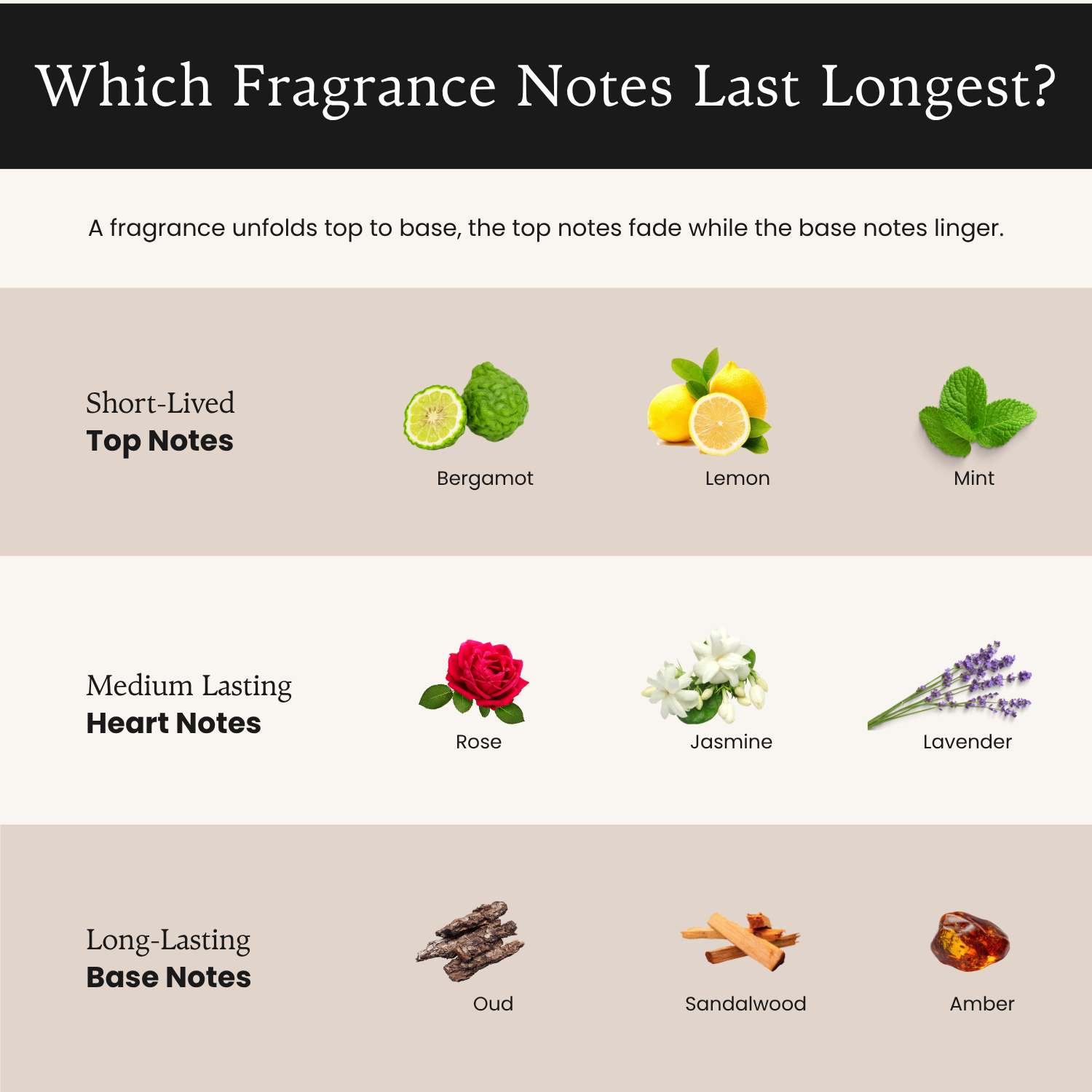
The base notes doing the heavy lifting each have their own deep-dive: sandalwood, oud, musk, amber, patchouli and vetiver.
Sillage, projection and longevity: what’s the difference?
These three terms get used interchangeably but mean different things. Longevity is how long you can still smell the fragrance on your skin. Projection is how far the scent radiates from your body in the first few hours. Sillage (French for “wake”) is the scented trail you leave behind as you move. A scent can be long-lasting but low-projecting (a “skin scent”), or a big projector that fades fast — concentration influences all three, but so do the notes and how much you apply.
How to make any fragrance last longer
You can stretch a scent’s wear time whatever its concentration. Apply to well-moisturised skin — fragrance clings to oil, so an unscented lotion or a matching body product gives it something to hold onto. Spray onto warm pulse points (neck, inner wrists, inner elbows) rather than rubbing, which can crush the top notes. Don’t overlook hair and clothing, which hold scent longer than skin. And store your bottles away from heat and light to protect the formula. For scents built to go the distance, see our roundup of the longest-lasting fragrances for men.
Related reading: how long does perfume last and does perfume expire.
How concentration affects price
The oils are the expensive part of a fragrance, so more oil means a higher sticker price. But the more useful number is price per wear. A concentrated parfum needs only a spray or two, so a bottle lasts far longer than a light EDT you spray six times a day. A 100 ml bottle holds somewhere between 750 and 1,500 sprays depending on the atomiser, which turns even a pricey bottle into pennies per wear once you actually use it. The costly mistake is rarely buying the stronger version — it’s buying the wrong scent in any concentration.
When to choose each
Match the concentration to the moment rather than assuming stronger is always better. Reach for parfum or EDP when you want presence and longevity: cold weather, evenings, dates, or a signature you want people to remember. Reach for EDT, EDC or a mist when you want freshness, comfort and the freedom to spray — hot days, the office, the gym, layering, or simply testing whether a scent earns a place in your rotation before committing to the pricier version. Many people keep an affordable EDT as a daily throw-it-on — our roundup of the best cheap colognes for men is a good place to start — and save a beloved parfum for occasions.
How to choose the right concentration
Choosing a concentration comes down to three questions: how long you need it to last, how much presence you want, and where you’ll wear it. For all-day wear or a signature scent, reach for an EDP or parfum. For fresh, everyday wear — especially in heat or close quarters — an EDT, cologne or mist is the smarter pick. If you’re trying a fragrance for the first time, start with the lighter, cheaper version to see whether you love it before investing in the concentrated one. And because two fragrances at the same concentration can perform very differently, test on your own skin whenever you can.
How many sprays should you use?
As a rule of thumb, the more concentrated the fragrance, the fewer sprays you need. Over-applying a concentrated scent is the fastest way to overwhelm a room, so start light — you can always add more.
| Concentration | Sprays |
|---|---|
| Parfum / Extrait | 1–2 |
| Eau de Parfum (EDP) | 2–3 |
| Eau de Toilette (EDT) | 3–5 |
| Cologne / Eau Fraîche / body mist | Spray freely, reapply |
Perfume vs cologne: the two meanings
“Cologne” is used two ways, which causes endless confusion. Strictly, eau de cologne is a concentration — a light, citrus-forward 2–4% formula. Colloquially, especially in the US, “cologne” just means any men’s fragrance while “perfume” is used for women’s. So a men’s eau de parfum is often called a “cologne” even though, by concentration, it’s parfum-strength. When in doubt, ignore the gendered label and read the concentration on the box. For the related product question, see body spray vs cologne.
Go deeper on the comparisons that matter
Once you know the ladder, the useful questions are the head-to-heads. The two you’ll choose between most often are covered in our full guide to Eau de Parfum vs Eau de Toilette. If you’re weighing a lighter option, see Body Mist vs Perfume and Body Spray vs Cologne. And if any of the terminology is new, our fragrance vocabulary dictionary decodes the rest. For a real-world example of how one scent changes across concentrations, see our Bleu de Chanel EDT vs EDP vs Parfum comparison.
Fragrance Concentrations FAQ
What are the perfume concentrations from strongest to weakest?
From most to least concentrated: parfum (extrait), eau de parfum, eau de toilette, eau de cologne, and finally eau fraîche and body mists. Oil content falls from roughly 20–40% at the top to 1–3% at the bottom, and longevity drops with it.
Does a higher concentration always last longer?
Usually, but not always. More oil generally means longer wear, yet longevity is driven as much by the actual materials as by the label. A woody, musky EDT built on long-lasting bases can outlast a light, citrusy EDP designed to fade gently.
What is the strongest fragrance concentration?
Parfum, also called extrait de parfum or pure perfume, is the strongest common format at around 20–40% oil. Some elixir and parfum intense versions are marketed as even richer, though elixir is not a fixed, regulated category.
Is parfum the same as perfume?
Not quite. Perfume is a general word for any scented product, while parfum (extrait) is a specific, high-concentration format. Confusingly, in French the word parfum simply means perfume, so always check the oil concentration rather than the name.
Why does the same scent cost more in a higher concentration?
Because the aromatic oils are the costly ingredient. A higher concentration packs more oil per bottle, which raises the price — but since you use less per wear, the price per spray often evens out.
Which concentration is best for everyday wear?
For most people an EDT or EDP is the everyday sweet spot: EDT for fresh, spray-freely wear, and EDP when you want more depth and staying power. Save parfum for occasions, and use mists for casual, generous refreshing.

Selena Marc is a fragrance enthusiast, freelance writer, and dog mom living in Houston, Texas. When she's not writing about her favorite new perfumes, you can find her enjoying yoga or a morning hike.