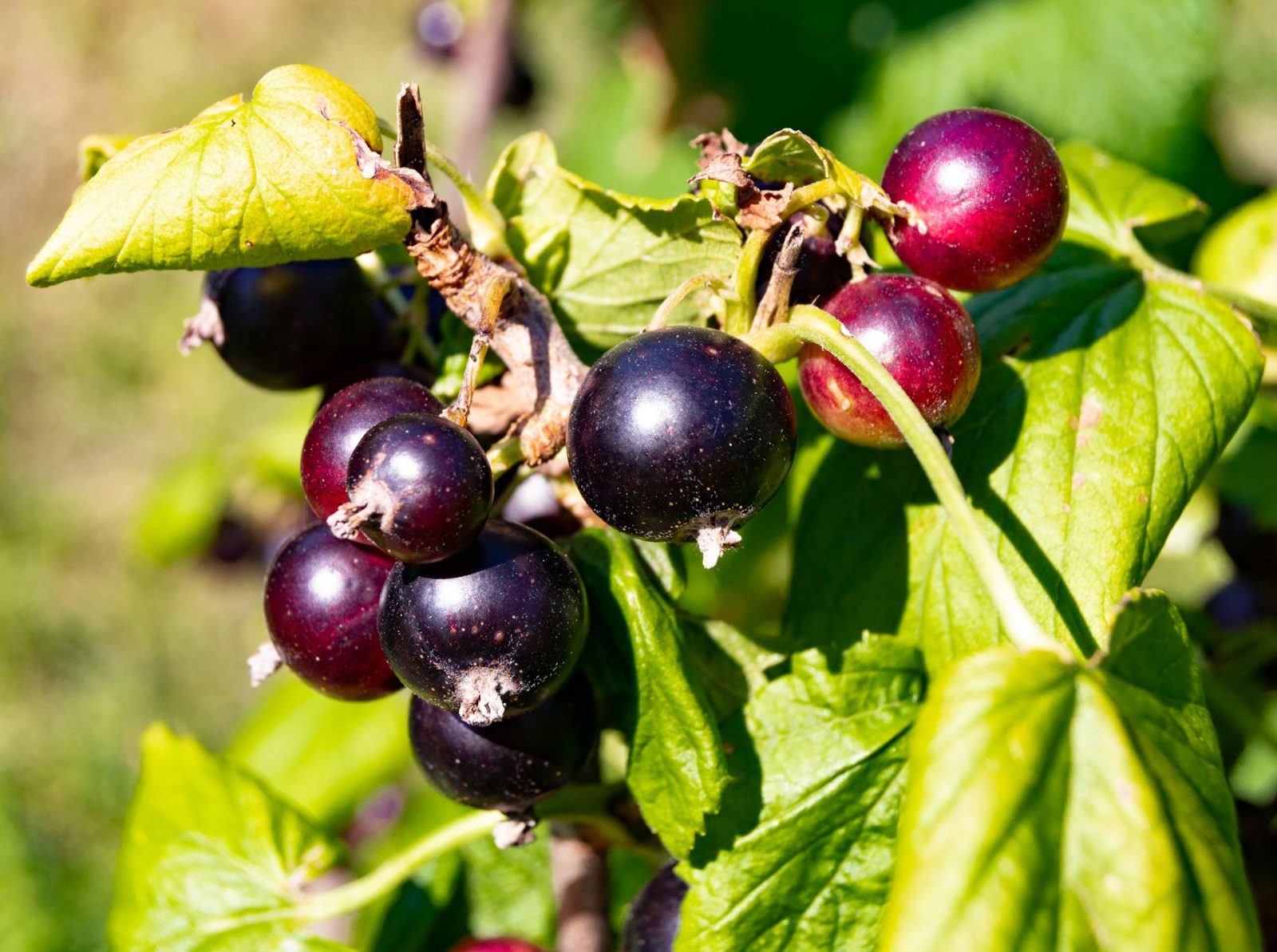
Ask what blackcurrant smells like and almost everyone answers with a memory of squash, jam or a purple boiled sweet. Dark, sweet, unmistakably fruit. That describes blackcurrant jam rather well, and it is close to useless for reading a note list, because the material perfumers reach for when they write “cassis” isn’t made from the berry at all.
It’s made from the buds. And it smells green, tart, resinous and — the part nobody warns you about — faintly of cat.
Which makes blackcurrant the most chemically interesting note in the fruity fragrance family. Nearly everything else on that shelf is a reconstruction: peach, raspberry, apple and pear are built from lactones and esters because no usable natural extract exists. Blackcurrant is the exception. It has a real one, in commercial use, and it is held together by sulphur.
What Does Blackcurrant Smell Like?
Blackcurrant in perfumery smells tart, green and sharply fruity, with a sulphurous, animalic edge that reads as catty or feline — closer to crushed leaf and blackcurrant skin than to the flesh. There’s a cool, minty lift over the top and a dry, resinous body underneath. It is bright, unsweet, and above a whisper it is confrontational.
Broken into facets:
- Tart green-fruit — blackcurrant skin rather than pulp, all acid and no jam. The facet everyone recognises.
- Sulphurous-catty — the ammoniac, feline, boxwood-under-a-hedge note. The facet that defines the material and the one the word “fruity” completely fails to prepare you for.
- Green-leafy — crushed foliage, stems, bruised herbs. Its passport into green fragrances.
- Minty-cooling — a thin, camphoraceous lift, more noticeable in dilution than in the neat material.
- Terpenic-woody — dry, resinous, faintly pine-like, from the terpenes that make up most of the extract by weight.
- Vinous-liqueurous — a boozy, cassis-crème darkness that arrives late and low.
Here is why “fruity” undersells it. The absolute is not a sweet material and does not behave like one. Dosed with any generosity it smells less like fruit than like a hedge someone’s cat has claimed. Its job is almost never to be recognised as blackcurrant — it’s to add tension, lift and a flicker of the animalic to things that would otherwise sit flat.
It Is Not the Berry
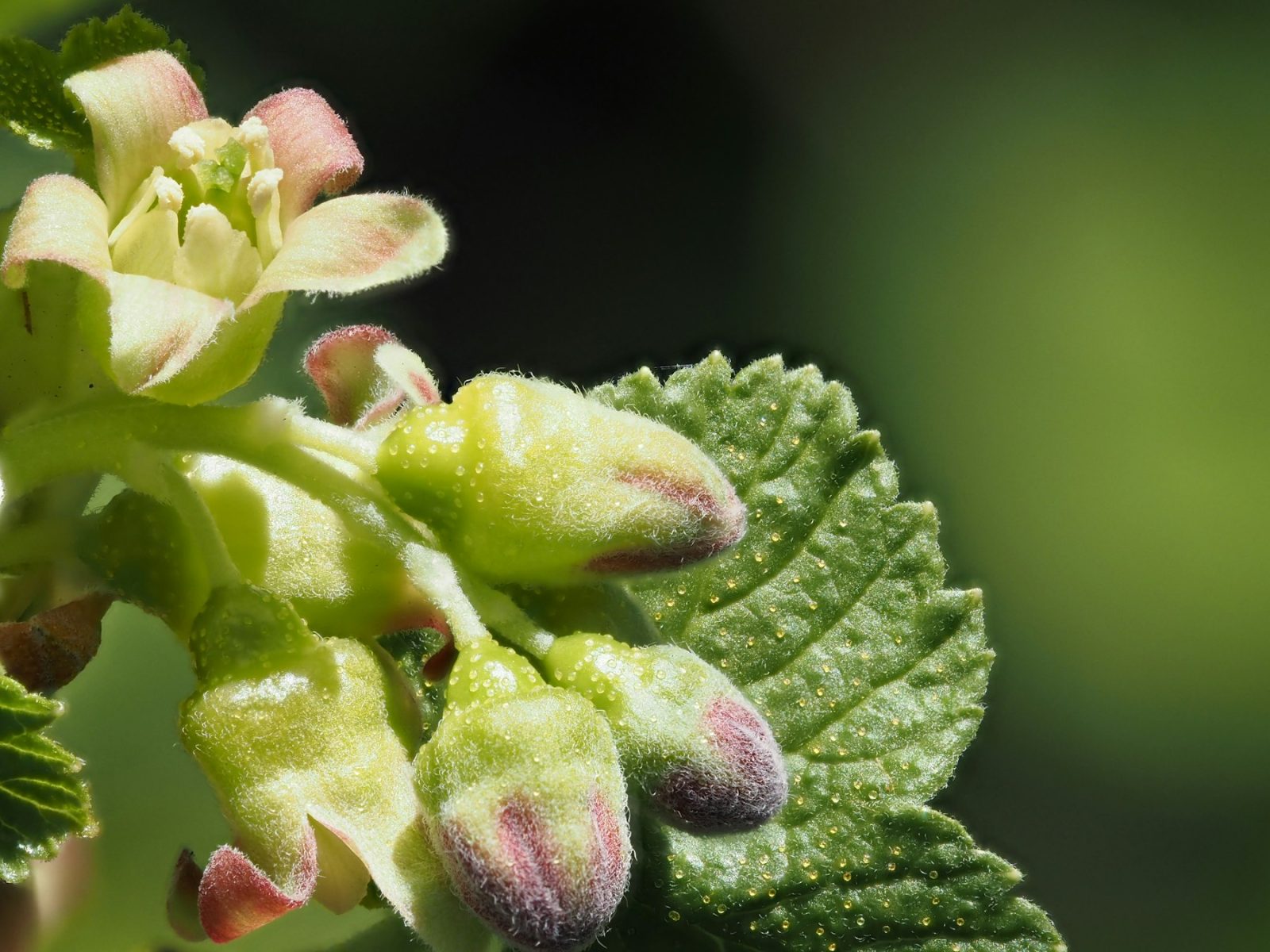
The material is bourgeons de cassis — blackcurrant bud absolute, from Ribes nigrum, harvested as dormant winter buds rather than summer fruit. Robertet gives the harvest as December to January; Givaudan puts the window from late November to February, picked in the afternoon once the plant has dried off.
That timing tells you most of what you need. These are not berries. They are tight, resinous, gland-covered buds gathered off bare canes in the cold, and the chemistry they carry is the plant’s defensive tooling, not its advertising to birds.
Extraction is the standard two-stage route: hydrocarbon solvent to a dark green concrete, then an alcohol wash and chill-filtration to the absolute. ScenTree puts the concrete yield at roughly 4% of fresh bud weight, with about 80% surviving into the absolute; a French supplier figure of 30 kg of buds per kilogram lands in the same neighbourhood. Both matter chiefly because they explain the price, which is at the top of the natural-materials scale.
The berry gives you nothing. You cannot usefully extract blackcurrant fruit into a perfumery material — the problem that afflicts strawberry, peach and every soft fruit. So when a pyramid says “blackcurrant” and means the sweet purple thing, that’s a synthetic accord. When it says “cassis” and means green, sour and slightly feral, it may well be the real absolute. The two share a plant and almost nothing else.
Where the Cattiness Comes From
The interesting bit is that the sulphur is a rounding error by weight.
Bulk analysis of the absolute is dominated by ordinary terpenes: ScenTree’s breakdown gives roughly 15% β-caryophyllene, 11% δ-3-carene, 10% terpinolene, with β-phellandrene and terpinen-4-ol around 5% each. A woody-green-resinous profile that, on its own, would smell like a conifer nobody had named yet.
What makes the material recognisable is a handful of thiols — sulphur-bearing compounds, also called mercaptans — present at levels far too small to register in that breakdown, and detectable by the nose at parts per billion. Three come up consistently in the literature:
| Compound | Also found in | Odour as described by suppliers and chemists |
|---|---|---|
| 4-methoxy-2-methyl-2-butanethiol (CAS 94087-83-9) | Blackcurrant buds; identified in some olive oils | “Sulfurous, catty, blackcurrant, minty, tropical” at 0.1% dilution; odour threshold in oil quoted at 0.03–0.06 ppb |
| 4-mercapto-4-methylpentan-2-one, the “cat ketone” (CAS 19872-52-7) | Sauvignon Blanc grapes, boxwood, Japanese green tea, cat urine | Blackcurrant at low concentration, unambiguously feline at high concentration |
| p-mentha-8-thiol-3-one, buchu mercaptan (CAS 38462-22-5) | Buchu leaf, blackcurrant, Sauvignon Blanc | Potent, sulphurous; described as blackcurrant or cat urine depending on dose |
Two things follow, and they are the whole story of the note.
First, concentration flips the meaning. These molecules are not “the smell of cat” that happens to turn up in fruit. They are genuinely bivalent: at parts per billion the brain files them as blackcurrant, at parts per million as something that has been marking territory. Perfumers are not adding an animalic note alongside the fruit. The fruit and the animal are the same molecule at different doses.
Second, the sulphur is why cassis smells nothing like jam. Cooking blackcurrants with sugar destroys or masks the volatile thiols and leaves the sweet cooked-fruit esters and the acids behind. Jam is what blackcurrant smells like once the interesting chemistry has been boiled off. The bud absolute is what it smells like beforehand.
The wine world reached the opposite verdict on the same chemistry, which we find quietly funny: in Sauvignon Blanc it is prized, called “blackcurrant bud” and “boxwood” in polite tasting notes and “cat pee” everywhere else, and treated as a marker of a good vintage.
The Buchu Connection
If you want to understand cassis, smell buchu.
Buchu is Agathosma betulina and its close relative A. crenulata, small aromatic shrubs from the Western Cape, whose leaf oil is the backbone of most commercial blackcurrant flavour profiles. The reason is direct: buchu leaf oil carries p-mentha-8-thiol-3-one — the same buchu mercaptan found in blackcurrant — which is why the oil reads minty, herbal and unmistakably cassis-like at once.
That also explains the minty facet in the absolute that puzzles people on first sniff. It is not an accident of blending. In buchu these sulphur compounds sit on a menthone skeleton, and the cool thiomenthone character travels with them. Perfumers reach for buchu to push the feline harder without spending more on an expensive absolute — standard practice rather than a trick.
Where It Comes From
Production is startlingly concentrated. Givaudan’s sourcing page puts Burgundy at 80–90% of world production of blackcurrant buds for perfumery, with secondary volumes from Poland, Moldova and Australia. The region grows blackcurrants principally for crème de cassis; the buds are the winter by-product of a liqueur industry, picked off the same canes in the dormant season.
Which is the genuinely unusual thing here. Most prized naturals are grown for perfumery and sold into it. Cassis absolute exists because Burgundy already had the bushes.
Cassis vs Synthetic Blackcurrant Bases
Alongside the natural, the industry runs a parallel set of cassis bases — pre-built accords sold as single ingredients, of which Firmenich’s Cassis Base 345B is the best known and the most widely available to independent perfumers. These are not attempts to clone the absolute. They are a different proposition: cleaner, sweeter, rounder, far cheaper, more stable, easier to dose.
They are also, in one narrow sense, better. The absolute is terpene-heavy, and ScenTree notes that those terpenes can polymerise on oxidation, creating solubility problems in a finished formula. A base doesn’t do that. If you want a legible blackcurrant that survives three years on a warm shelf, the base is the professional answer.
What it gives up is the tension. Strip out the green-terpenic body and the animalic undertow and you get a pleasant, purple, slightly candied fruit — the register that made cassis a fruity-floral fixture from the late 1980s onward, and that is responsible for a great deal of fairly interchangeable perfumery. The absolute is difficult, expensive and unstable. It is also the only version that sounds like it means something.
How the four materials compare
These are Everfumed editorial scores describing how each material typically reads in a finished composition — directional, not laboratory data. Scale is 0 (absent) to 10 (dominant).
| Facet | Blackcurrant bud absolute | Cassis base (synthetic) | Jammy blackcurrant accord | Buchu leaf oil |
|---|---|---|---|---|
| Tart green-fruit | 8 | 7 | 4 | 5 |
| Sulphurous / catty | 9 | 4 | 1 | 8 |
| Green-leafy | 8 | 3 | 1 | 6 |
| Minty-cooling | 5 | 2 | 0 | 8 |
| Terpenic-woody | 7 | 2 | 1 | 6 |
| Jammy sweetness | 2 | 6 | 9 | 0 |
| Diffusive power | 8 | 7 | 5 | 8 |
| Formula stability | 4 | 9 | 8 | 5 |
Read the sulphurous row against the jammy row and the whole argument is there in two lines. Nothing that scores high on one scores high on the other, and no material in the column set does both.
Its Real Job: Green and Chypre Structures
Blackcurrant’s structural importance has almost nothing to do with being fruit.
In green compositions, cassis does a job galbanum can’t: it supplies bitter, leafy, crushed-stem greenness with a fruit-acid brightness attached, which stops a green accord reading purely severe. Set against bergamot up top it gives that cold, wet, just-past-dawn effect the great green florals of the 1970s were built on.
In the chypre fragrance family its role is more precise. The classical chypre is citrus over labdanum over oakmoss — bright acid on top, damp earth beneath. Drop cassis into the top and it does two things at once: it extends the citrus past the point where bergamot would have evaporated, and its sulphurous edge shakes hands with the inky, animalic darkness of the moss below. Very few materials talk to both ends of a chypre at the same time. The green chypre is essentially what happens when a perfumer makes that move deliberately.
The animalic point is worth sitting with, because it inverts the usual arrangement. In most perfumery the animalic material is a base note — civet, castoreum, musk, the darkness at the bottom. Cassis puts the animalic at the top, inside something everyone reads as fruit. That is a rare and slightly subversive position, and it is why the note has never quite settled into the family it’s filed under.
Why Perfumers Use It in Trace Amounts
Trace, or nothing. Blackcurrant bud absolute is dosed in fractions of a percent, and the reasons stack.
The thiols are perceptible at parts per billion, so a formula needs very little to register it. The catty facet scales unhelpfully: nudge the dose and you don’t get more blackcurrant, you get less blackcurrant and more litter tray, with no useful plateau in between. The absolute is among the most expensive naturals on a bench. And the terpene load brings the solubility problems already mentioned. For a sense of scale, one supplier’s page for the isolated 4-methoxy thiol cites an IFRA recommendation of up to 0.01% in a fragrance concentrate.
So cassis is almost always seasoning rather than subject. When a pyramid leads with blackcurrant, you’re very probably reading a base or a fruity accord. When cassis is genuinely doing the work it often isn’t printed at all — it’s the reason the top note has an edge you can’t name.
A Short History of the Note
Cassis arrived in fine fragrance late, and it arrived green.
Guerlain’s Chamade (1969, Jean-Paul Guerlain) is the composition most consistently credited with putting blackcurrant bud absolute on the map, and is routinely called the first significant use of the material — the accepted account rather than a documented one. Van Cleef & Arpels’ First (1976, Jean-Claude Ellena) and Annick Goutal’s Eau de Charlotte (1982) followed in the same slightly feral register.
The 1970s green chypres are where the note found its structural home. Chanel’s Cristalle (1974, Henri Robert) is the era’s reference point — citrus, hyacinth and moss, the kind of composition whose cold, tart, leafy top is exactly what cassis exists to produce. Whether the absolute is in the formula is not something Chanel has published, and we’d rather say so than pretend otherwise.
Then the shift. Through the Poison era of the mid-1980s and the fruity-floral boom that followed, the cassis effect went mainstream via synthetic bases rather than the absolute — Tiffany (1987) and Lancôme Poème (1995) are the examples usually cited — and blackcurrant stopped being a green note and became a purple one. By the 2000s “blackcurrant” on a pyramid meant sweet, and the sulphur had been designed out.
That’s the arc worth carrying: one of perfumery’s few genuinely animalic fruits, tamed by better chemistry and cheaper economics. Not a tragedy — the bases do a real job — but a loss of nerve.
What Pairs Well With Blackcurrant
- Bergamot and citrus — extends the top and sharpens the acid. The default opening.
- Galbanum and violet leaf — doubles the bitter green. Severe, and the classical green-floral route.
- Oakmoss and patchouli — the chypre handshake; the sulphur meets the ink.
- Rose — the great pairing. Cassis makes rose smell freshly cut and slightly bloody rather than powdery.
- Buchu — reinforces the feline and the mint. The professional’s amplifier.
- Jasmine and white florals — a tart green edge stops indolic flowers from turning cloying.
- Peach and raspberry lactones — pushes cassis toward the sweet fruity-floral register.
- Vetiver and cedar — grounds the terpenic body and holds the brightness up.
- Mint and shiso — leans into the cool, green, herbaceous facet.
Where to Smell It Next
Understanding a material is one job; finding it on skin is another, and we keep the two apart. If you want blackcurrant in a bottle rather than on the page, our roundups pick up exactly where this guide stops: the 10 best fruity perfumes for women covers the tart and the jammy ends of the family, cassis included, and the best fruity colognes for men does the same on the masculine side. The fruity fragrance family hub maps the wider genre, and the fragrance vocabulary will define anything here you’d like unpacked.
Final Thoughts
Blackcurrant is filed under fruity, and the filing is the problem. Everything worth knowing lives on the other side of that label: a natural extract in a family built on reconstructions, harvested from bare winter canes rather than summer fruit, holding its identity together with sulphur compounds you can smell at parts per billion, and doing its best work as an animalic note at the top of a green chypre.
The useful test separates the material from the marketing. If a blackcurrant smells sweet, purple and comfortable, you’re smelling a base — and there’s nothing wrong with that. If it smells tart, leafy, faintly mineral and just slightly as though something has been in the garden, you’re smelling the real thing, or a perfumer confident enough to make a base behave like it.
Learn the second version and a lot of green perfumery falls into place. Browse the rest of our fragrance notes library for the materials it sits beside.
Blackcurrant FAQs
What does blackcurrant smell like in perfume? Tart, green and sharply fruity, with a sulphurous, catty edge, a cool minty lift and a dry resinous body. It reads as blackcurrant skin and crushed leaf rather than sweet cooked fruit, and it sits in the top of a composition, adding brightness and tension.
What is cassis in perfume? Cassis is French for blackcurrant, and in perfumery it usually means blackcurrant bud absolute — bourgeons de cassis — extracted from the winter buds of Ribes nigrum rather than the berries. It is one of very few genuinely natural extracts in the fruity family.
Why does blackcurrant smell like cat pee? Thiols — sulphur compounds including 4-methoxy-2-methyl-2-butanethiol and the so-called cat ketone, 4-mercapto-4-methylpentan-2-one. The same molecules read as blackcurrant at very low concentrations and as feline at higher ones. Fruit and animal are one chemistry at two doses.
Why doesn’t cassis smell like blackcurrant jam? Jam is cooked. Heat and sugar destroy or mask the volatile thiols and leave the sweet fruit esters and acids behind. The bud absolute captures the material before any of that happens, which is why it smells green and animalic rather than sweet.
Is blackcurrant a natural or synthetic perfume note? Both exist, and they smell different. Blackcurrant bud absolute is a real natural extract, expensive and used in traces. Most sweet, jammy blackcurrant comes from synthetic cassis bases, which are cleaner, cheaper and far more stable.
Where does blackcurrant bud absolute come from? Overwhelmingly Burgundy, which supplier documentation puts at 80–90% of world production of blackcurrant buds for perfumery, with smaller volumes from Poland, Moldova and Australia. The buds are a winter by-product of the crème de cassis industry.
What is buchu, and why is it linked to blackcurrant? Buchu is a South African shrub, Agathosma betulina, whose leaf oil contains p-mentha-8-thiol-3-one — the same sulphur compound found in blackcurrant. It smells minty, herbal and distinctly cassis-like, and is used both to build blackcurrant flavours and to reinforce the feline facet.
Does blackcurrant last long on skin? No. It is a volatile, diffusive top-note material that declares itself in the first twenty minutes. What lasts is whatever it was paired with — moss, woods, musks or the sweeter accords beneath it.
Which fragrance families use blackcurrant? Fruity most obviously, but its best work is in green compositions and chypres, where it bridges the citrus top and the animalic, mossy base. It is also standard in modern fruity-florals, almost always as a synthetic base.
Related on Everfumed
- Fruity Fragrance Family: Notes, Scent Profile & History
- 10 Best Deliciously Fruity Perfumes for Women
- Sweetly Masculine: Best Fruity Colognes for Men
- Best Green Fragrances
- Chypre Fragrance Family: Notes, Scent Profile & Best Perfumes
- What Does Oakmoss Smell Like?
- What Does Bergamot Smell Like?
- Fragrance Vocabulary
- All Fragrance Notes

Selena Marc is a fragrance enthusiast, freelance writer, and dog mom living in Houston, Texas. When she's not writing about her favorite new perfumes, you can find her enjoying yoga or a morning hike.