Ask what tea smells like and most people answer without hesitating, which is the tell. They’re picturing one thing — something pale, green, faintly grassy, vaguely virtuous — and they’re describing perhaps a fifth of the territory.
Tea is not a note. It’s a category of notes that a century of pyramid-writing has flattened into a single word. Green tea is fresh and vegetal and belongs squarely in the fresh fragrance family. Black tea is dry, tannic and woody, and belongs nowhere near it. Matcha is a third thing again, thicker and more mineral than either. Earl Grey is not a tea note at all, it’s a citrus note wearing a tea costume. And lapsang souchong is a smoke note that happens to have started as a leaf.
Five propositions, three families, one word on the box. So: what each of them actually smells like, why the material behind the note is almost never the leaf itself, and how tea became perfumery’s shorthand for quiet.
What Does Tea Smell Like?
Tea smells dry, green and softly bitter, with a papery, faintly hay-like texture and a cool astringency that pulls the mouth in rather than pushing the nose back. It is a quiet, low-contrast note — more shade than colour — and the thing that makes it read as tea rather than as generic greenery is tannic dryness.
Broken into facets:
- Green-vegetal — cut grass, crushed leaf, cucumber skin. Sharpest in green tea, near-absent in black.
- Tannic-astringent — the drying, mouth-puckering quality of stewed leaves. The signature facet, and the hardest to fake.
- Hay-papery — dried grass, old books, the inside of a tea caddy. Comes forward as the note dries down.
- Smoky-tarry — pine smoke and tar, restricted almost entirely to lapsang and its imitators.
- Floral-honeyed — a soft apricot-and-rose warmth that appears in oolong and in good black tea reconstructions.
- Mineral-saline — a cool, wet-stone quality, most obvious in matcha, which is why matcha accords read thicker than green tea ones.
Nothing on that list is loud. That is the point of tea, and it’s why the note took so long to arrive and then never left.
Five Teas, Five Different Notes
Here is the split the note lists refuse to make.
Green tea
Unoxidised leaf, either steamed or pan-fired. In fragrance it reads bright, watery, grassy and slightly bitter, with a lemony lift — the reason it so often arrives sitting on citrus. This is the version that gave tea its reputation for cleanliness, and it lives in the fresh fragrance family alongside the citruses and the aquatics rather than with the woods. If a fragrance says “tea” and smells like a cold flannel in the best possible way, it’s green.
Matcha
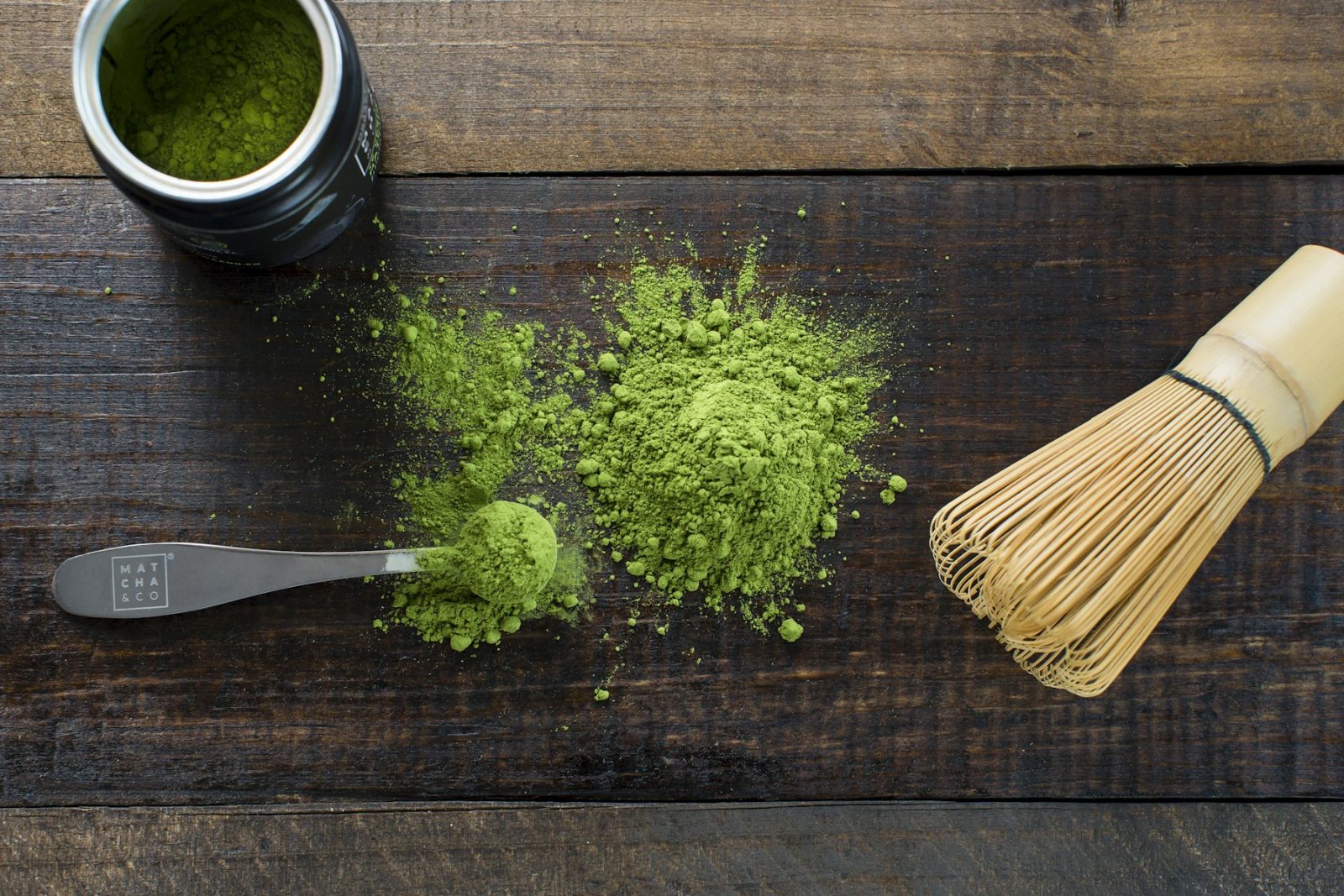
Shade-grown, stone-ground whole leaf, and a genuinely different olfactory object. Where green tea is watery, matcha is powdery and dense — a chalky, mineral, faintly marine bitterness with a milky edge that has nothing to do with added dairy. It’s the most textural of the five. Perfumery has only started using it properly in the last decade, and it usually turns up as a modifier that thickens a green tea accord rather than as a subject in its own right.
Black tea
Fully oxidised, and the point at which tea stops being green. It smells dry, tannic, leathery and warm, with a stewed-fruit sweetness underneath and a distinctly woody grain. It is a base-adjacent material rather than a top note, and it belongs with the woody family far more than with the fresh one. The nearest structural cousin is cured tobacco leaf — same crop-into-commodity story, same transformation happening during processing rather than in the field.
Earl Grey
Here is the useful correction. Earl Grey is black tea flavoured with bergamot oil, and when a fragrance announces Earl Grey what you are overwhelmingly smelling is the bergamot: bright, bitter, floral-citrus, slightly soapy at the edges. The tea is the backdrop. Perfumers know this perfectly well and use “Earl Grey” as a licence to build a bergamot-forward cologne with a dry finish — which is a good trick, and an honest one, provided nobody pretends the leaf is doing the work. Earl Grey is not a tea note. It’s a bergamot note with a tannin problem solved.
Lapsang souchong
Black tea from the Wuyi mountains of Fujian, dried over burning pine. The smoke is not a metaphor. Lapsang smells of tar, pine resin, campfire and creosote, and in fragrance it functions as a smoke material — closer to birch tar or guaiacol than to anything in the green tea family. When people say they find tea notes “too intense,” they have usually met a lapsang and filed it under the wrong heading. Lapsang is a smoke note.
The five compared
These are Everfumed editorial scores describing how each type typically reads in a finished composition — directional, not laboratory data. Scale is 0 (absent) to 10 (dominant).
| Facet | Green tea | Matcha | Black tea | Earl Grey | Lapsang souchong |
|---|---|---|---|---|---|
| Green-vegetal | 9 | 7 | 2 | 3 | 1 |
| Tannic-astringent | 6 | 7 | 9 | 6 | 7 |
| Hay-papery | 4 | 3 | 7 | 5 | 5 |
| Smoky-tarry | 0 | 1 | 3 | 1 | 10 |
| Floral-honeyed | 3 | 2 | 6 | 5 | 2 |
| Mineral-saline | 4 | 8 | 2 | 2 | 3 |
| Citrus lift | 5 | 2 | 2 | 9 | 1 |
| Position in the structure | Top | Top–heart | Heart–base | Top | Base |
Read down the smoke column and the case for splitting the note makes itself. Read across the bottom row and you can see why “tea” behaves so unpredictably in a pyramid: depending on which tea, it belongs at either end of the composition.
The Material Problem: Tea Absolute Exists, and It Doesn’t Smell Like Tea
This is the part the note lists never mention, and it explains almost everything.
Tea absolute is real. Leaves of Camellia sinensis are solvent-extracted, usually in France from Chinese material, and the result is a dark, viscous, tenacious substance that perfumers do buy. It is not cheap: one long-established supplier lists green tea absolute at roughly €900 per kilo wholesale, which puts it in the same conversation as a mid-tier floral absolute rather than a commodity.
And here is the catch. It doesn’t smell much like a cup of tea. Supplier descriptions of green tea absolute reach for hay, tobacco leaf, clary sage, tanned leather and — repeatedly — seaweed. Customer notes say the same. That is a fine, useful, characterful material. It is not the bright vegetal freshness that the word “tea” puts in a reader’s head.
The reason is processing. Most of what we recognise as the aroma of tea is generated during withering and oxidation, when carotenoids in the leaf are broken down enzymatically into a family of volatile fragments. Extract the leaf and you capture a lot of heavy, green, leathery material and comparatively little of the light, recognisable stuff — much of which is too volatile or too fragile to survive.
So tea accords are built, not extracted. The absolute goes in as a modifier and a fixative, and the tea character itself is constructed from aroma chemicals: theaspirane for the herbal-green-woody spine, beta-damascenone for a honeyed darkness at vanishingly low doses, alpha- and beta-ionone for a powdery violet-leaf softness, dihydroactinidiolide for apricot warmth, and cis-3-hexenol for the sharp cut-grass top. Linalool and methyl salicylate turn up too, for lift and for the wintergreen-adjacent coolness that reads as astringency.
Which is worth saying plainly, because the marketing rarely does: when a bottle says green tea, you are smelling a reconstruction with, at best, a little real leaf extract in it. That is not a scandal. Nearly every note behaves this way. It just makes the ones that get the reconstruction right more impressive, not less.
Why Tea Reads as “Clean” — and How That Became a Genre
Tea is quiet. It has no sugar, no animal, no obvious flower, and almost no projection; it sits close and does very little. In the mid-1990s that was a radical proposition, arriving directly after a decade of fragrances designed to be smelled from the far end of a restaurant.
Two releases turned it into a category. Bulgari’s Eau Parfumée au Thé Vert (1992, Jean-Claude Ellena) put green tea at the centre of a cologne structure and, crucially, made restraint the point rather than a limitation. Seven years later Elizabeth Arden’s Green Tea (1999, credited to Francis Kurkdjian) took the same idea to the drugstore at a fraction of the price and sold it in volumes the niche world never touches. One made tea respectable; the other made it universal.
What both understood is that tea’s cleanliness is a dry cleanliness. Soap is clean because it’s fatty and alkaline and slightly sweet. Tea is clean because it’s astringent — it reads as scrubbed rather than as lathered. That distinction is the entire difference between a tea accord that works and one that smells like hotel hand wash, and it’s why so many “tea” fragrances in the two decades since have missed: they reached for white musks and aldehydic freshness to signal cleanliness and lost the bitterness that made it tea in the first place.
Tea also sits at an awkward and rather brilliant junction between the fresh, the green and the woody families, belonging fully to none. That ambiguity is why it has outlasted every fresh-note fashion that arrived alongside it. Ozonics dated. Calone dated. Tea didn’t, because tea was never really about freshness.
Tannin Is the Whole Test
If you want one diagnostic for a tea note, use this: does it dry your attention out?
A good tea accord has a pucker. There’s a moment fifteen or twenty minutes in where the green top has burned off and what’s left is papery, faintly bitter and slightly rough, like the finish of a cup that steeped a minute too long. That roughness is what stops the note collapsing into generic freshness.
A bad tea accord skips it. It gives you the grassy opening, then hands straight over to musk and a soft floral, and the result is pleasant, inoffensive and completely anonymous — a fabric-softener scent with a leaf drawn on the box. There is a great deal of this about, and it’s the reason plenty of people think they dislike tea fragrances when what they dislike is laundry.
The tannic finish is also the facet that behaves best with time. Green top notes are gone inside half an hour; the dry, hay-papery, slightly bitter residue is what carries a tea composition into hour two and three, usually with woods or a light musk underneath doing the actual lifting. Judge a tea fragrance on a blotter at the two-minute mark and you’ll learn nothing except whether you like cut grass.
What Pairs Well With Tea
- Bergamot and citrus — the Earl Grey axis and the standard green-tea opening. Bitter citrus and tannin are natural allies.
- Jasmine and orange blossom — the classical scenting flowers for tea itself, and the pairing that keeps a green accord from turning severe.
- Mint and violet leaf — doubles the cool green. Sharp, and easily overdone.
- Fig, apricot and white peach — soft fruit rounds off black tea’s tannin the way a spoon of jam does.
- Cardamom and ginger — the chai direction; spice gives black tea a warmth it can’t generate alone.
- Smoke, birch tar and tobacco — the lapsang route, and the point at which tea stops being a fresh note entirely.
- Cedar, vetiver and dry woods — structural support for black tea, which needs a floor.
- Iris and light musk — powdery, cool, and the safest way to extend a green tea into a base without sweetening it.
- Milk and rice notes — the modern matcha move; adds body without adding sugar.
Where to Smell It Next
Understanding a note is one job; finding it on skin is another, and we keep the two apart. If you want tea in a bottle rather than on the page, our roundup of the 15 best tea fragrances picks up exactly where this guide stops — the green tea colognes, the black tea woods, the smoky ones and the milky matcha interpretations, sorted by which of the five propositions above they’re actually built on. Read this page to understand the note; read that one to find it. The fresh fragrance family guide covers the wider structure the green half of tea belongs to, and the fragrance vocabulary will decode anything here you’d like defined.
Final Thoughts
Tea is the most under-specified note in mainstream perfumery. Nobody writes “flower” on a pyramid and expects to be taken seriously, yet “tea” gets printed on compositions ranging from a cold citrus cologne to a tarry smoke bomb, and readers are left to work out which they’ve bought after the fact.
The fix is not complicated. Ask which tea. Green means fresh, vegetal and short. Matcha means powdery, mineral and thicker. Black means dry, tannic and woody, and it will sit lower in the structure than you expect. Earl Grey means bergamot, whatever else it means. Lapsang means smoke, and if you don’t like smoke you will not be rescued by the word tea.
Get that far and the note stops being a lottery. It also becomes rather easy to admire — because for something with no sweetness, no animal warmth and almost no volume, tea has held a place on the shelf for thirty years by doing the one thing very few materials manage. It suggests restraint without smelling of nothing.
Browse the rest of our fragrance notes library for the neighbouring materials.
Tea FAQs
What does tea smell like in perfume? Dry, green and softly bitter, with a papery hay-like texture and a tannic astringency that reads as scrubbed rather than lathered. The specifics depend entirely on which tea: green tea is grassy and watery, black tea is dry and woody, matcha is powdery and mineral, and lapsang souchong is frankly smoky.
Is tea a fresh note or a woody note? Both, depending on the type. Green tea and matcha sit in the fresh family alongside citrus and aquatics. Black tea and lapsang sit much closer to the woody and smoky end, and behave as heart or base materials rather than top notes.
What does green tea smell like in fragrance? Bright, watery and grassy with a lemony lift and a light bitter edge. It’s the version that made tea a category in the 1990s, it lives in the top of a composition, and it typically burns off inside half an hour, leaving a dry papery residue behind.
What does black tea smell like in perfume? Dry, tannic and leathery, with stewed-fruit sweetness and a woody grain. It behaves almost like a base material and pairs naturally with cedar, tobacco and dried fruit. It is a genuinely different note from green tea, despite sharing a name.
Is Earl Grey a tea note? Not really. Earl Grey is black tea flavoured with bergamot oil, and in fragrance the bergamot does most of the work — bright, bitter, floral citrus with a dry finish. Treat an Earl Grey listing as a signal that you’re getting a bergamot-forward composition.
Does lapsang souchong smell smoky? Very. Lapsang is dried over burning pine, and it smells of tar, resin and campfire. In perfumery it functions as a smoke material rather than a tea one, which is why it turns up beside birch tar and leather rather than beside citrus.
Is there such a thing as tea absolute? Yes. Tea leaves are solvent-extracted to produce an absolute, and it is expensive. It also doesn’t smell much like brewed tea — suppliers describe hay, tobacco, leather and seaweed — so it’s typically used as a modifier and fixative while the recognisable tea character is reconstructed from aroma chemicals.
Why do some tea fragrances smell soapy? Because the tannin has been left out. A tea accord that hands straight from a grassy opening to white musk and soft florals loses the dry, slightly rough bitterness that makes it read as tea, and what’s left is generic cleanliness. The pucker is the point.
Does tea last long on skin? Not the green part. The vegetal top notes are short-lived, usually under an hour, while the papery-tannic residue carries into hour two or three with help from woods and musks. Black tea and lapsang accords last considerably longer because they sit lower in the structure.
Related on Everfumed
- 15 Best Tea Fragrances: Unique, Aromatic & Refreshing
- Fresh Fragrance Family: Citrus, Aquatic & Green Notes
- What Does Bergamot Smell Like?
- What Does Tobacco Smell Like?
- Woody Fragrance Family: Notes, Scent Profile & Best Perfumes
- 26 Best Green Fragrances
- Fragrance Vocabulary: Dictionary to Perfumes
- All Fragrance Notes

Selena Marc is a fragrance enthusiast, freelance writer, and dog mom living in Houston, Texas. When she's not writing about her favorite new perfumes, you can find her enjoying yoga or a morning hike.