This ought to be the easiest note on the site. Everybody knows what caramel smells like — sugar, heat, butter, a kitchen. You have the reference in your head already and no perfumer needs to explain it.
Then you go looking for the material and there isn’t one.
There is no caramel extract, no caramel absolute, no distillation of a saucepan. Caramel in perfumery is an effect — a small set of extremely powerful synthetic molecules arranged to trigger a memory of cooked sugar. It obeys different rules from an extracted natural, and those rules explain both the best gourmands ever made and the great mass of sweet, indistinguishable ones. So: what caramel smells like, the molecules that do it, the fragrance that made it a genre, and why it goes wrong more often than any other note in perfumery.
What Does Caramel Smell Like?
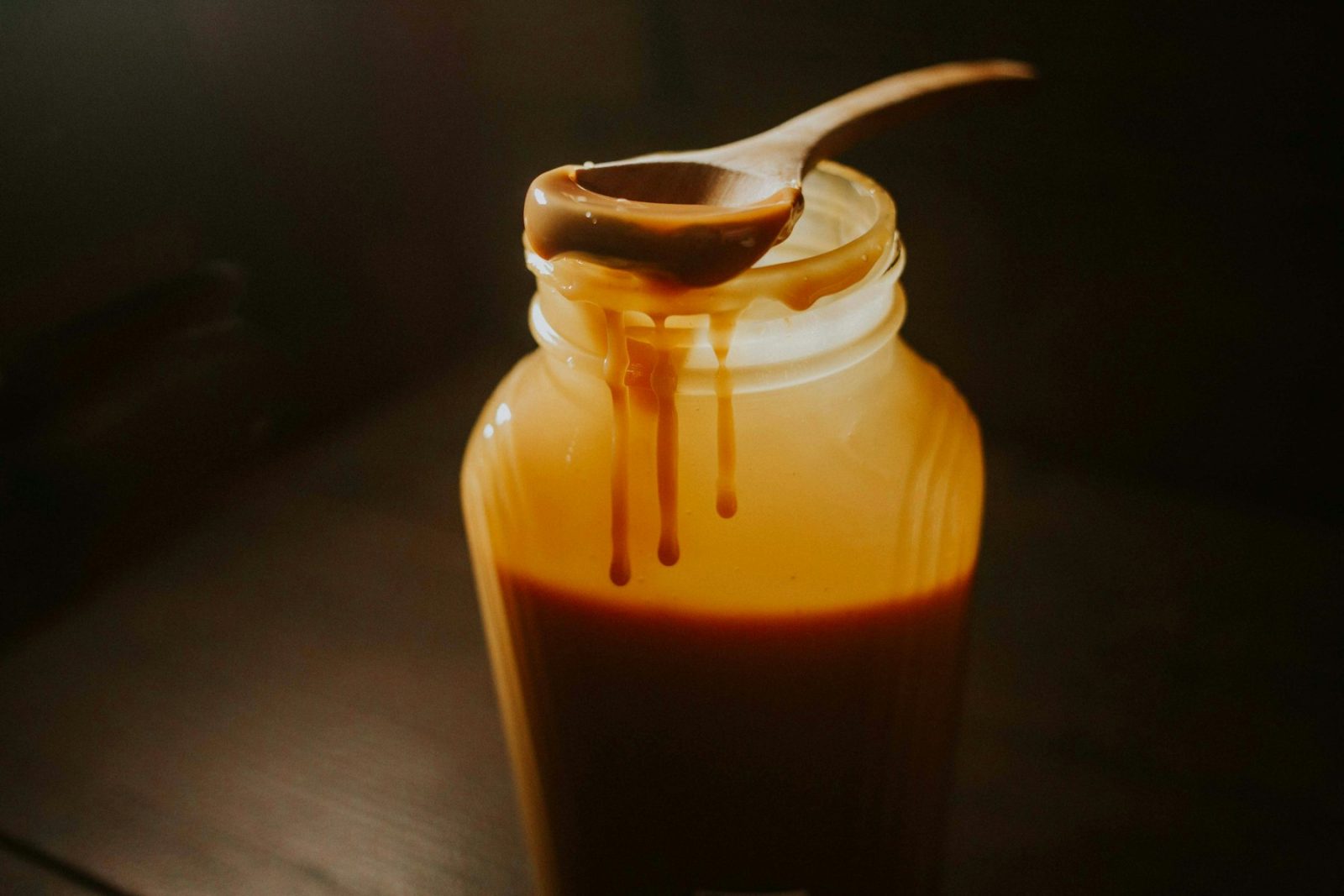
Caramel smells warm, sweet and toasted — spun sugar and burnt sugar at once, with a buttery, faintly milky richness in the middle and a dry, slightly bitter char at the edge. In perfume it reads sweeter and more artificial than kitchen caramel: brighter, pinker, closer to fairground candyfloss than to a sauce on a stove. It is a tenacious base-to-heart effect and one of the most diffusive things a perfumer can use.
Broken into facets:
- Candyfloss-sweet — spun sugar, fairground, faintly strawberry-tinted. The dominant facet in almost all modern caramel accords, and the one people mean when they call a fragrance “sweet”.
- Burnt-sugar — dry, dark, slightly bitter and smoky. The facet that gives caramel adult credibility and the first one to be cut when a brief says “approachable”.
- Buttery-lactonic — creamy, dairy, soft. This is toffee’s territory and where caramel borders on vanilla.
- Toasted-nutty — bread crust, roasted malt, praline. Comes from the same chemistry as coffee and cocoa.
- Jammy-fruity — cooked strawberry, stewed apple. A furanone signature, and the reason cheap caramel can smell oddly fruity.
- Salty-mineral — a thin savoury edge, mostly implied rather than present, and the modern fix for excessive sweetness.
The important thing about that list is that only one facet — the candyfloss — is genuinely easy to achieve. The other five are what separate a caramel that smells like a material from one that smells like a sweetener.
There Is No Caramel Extract
Real caramel is a cooking process, not a plant. Heat sugar past about 160°C and it decomposes and recombines into hundreds of new compounds, most volatile, many fleeting. Add milk proteins and you get browning of a different kind — the Maillard reaction, the chemistry behind bread crust, roasted coffee and seared meat.
Neither process yields anything a perfumer can put in a formula. There is no way to distil a saucepan, and the aroma of cooked sugar is too unstable to survive extraction. What the industry has instead is a handful of synthetics that each capture one slice of the effect, and a long tradition of arranging them to imply the rest.
That makes caramel a fantasy note: an accord named for something never extracted. Leather works the same way, as do marine notes and most fruit. It is not a lesser category. It does mean the note has no benchmark — no reference material against which a version can be judged right or wrong — so what “caramel” smells like is decided by convention, and convention is set by whichever fragrance sold best.
Ethyl Maltol Runs the Genre
The centre of perfumery caramel is one molecule: ethyl maltol (CAS 4940-11-8). If you have smelled a sweet fragrance made in the last thirty years, you have smelled it, almost certainly at a level you noticed.
It smells of candyfloss. Sugary, caramelised, jammy, with a strawberry tint — spun sugar at a fairground rather than sugar in a pan. It is enormously powerful, it diffuses, and it makes everything around it read sweeter than it is. That last property is the commercially important one. Ethyl maltol is not really a caramel note; it is a sweetness signal, and it works on a formula the way MSG works on a stock.
Its parent molecule, maltol (CAS 118-71-8), was identified in larch bark and later found in roasted malt, cocoa, coffee and bread crust — all Maillard products, which is the tell. Maltol smells similar but softer, warmer and less sugary. Ethyl maltol, the synthetic analogue, is variously reported at four to six times stronger, and it is the pinker, more diffusive of the two. It is also the one that gets overused, for the obvious reason that it is cheaper per unit of effect.
Around that pair sit the supporting molecules.
| Material | Smells like | Role in a caramel accord |
|---|---|---|
| Ethyl maltol | Candyfloss, jammy, caramelised, faintly strawberry | The centre. Sweetness signal and diffusion engine. Typically reported around 0.05–0.3% |
| Maltol | Toasted sugar, warm, softer, more “cooked” | The grown-up version. Adds bakery warmth without the pink. Usually dosed below 0.05% |
| Furaneol (DMHF) | Cooked strawberry jam, burnt sugar, intensely sweet | Trace modifier. Supplies the jammy-fruity facet. Detectable at parts per billion; overdoses cloy instantly |
| Sotolon | Curry, fenugreek, maple syrup, caramel at dilution | Dark, savoury depth. Ferociously strong; a hair too much and the fragrance smells of curry |
| Cyclotene | Maple, burnt sugar, roasted, slightly bitter | Pushes the accord toward the char end and away from candyfloss |
| Vanillin / ethyl vanillin | Vanilla, sweet, creamy | Not caramel, but present in nearly every caramel accord as the softening agent |
| Lactones (γ-decalactone and relatives) | Creamy, coconut-peach, buttery | Supplies the dairy fat that turns caramel into toffee |
Note how many are borrowed from flavour work rather than fine fragrance. Caramel is one of very few accords whose palette came up through the food industry first, and it shows in how the materials behave: potent, cheap, effective at trace levels, unforgiving.
The Maillard Reaction Is the Real Referent
Worth being precise about, because the two browning reactions produce different smells and perfumers exploit both.
Caramelisation is sugar alone, decomposing under heat. It gives the dry, bitter, burnt-sugar facet — a syrup taken one shade too far.
The Maillard reaction is sugar plus amino acids, and it is the richer of the two. It produces the toasted, nutty, bready, roasted character shared by bread crust, malt, coffee, chocolate and, crucially, dulce de leche and toffee. Maltol and cyclotene are Maillard products. So is a great deal of what makes gourmand fragrances smell like food rather than like sweets.
The practical upshot is a lever. A caramel accord built mostly on ethyl maltol reads as confectionery — sweets, fairgrounds, childhood. One built with maltol, cyclotene and a little sotolon reads as cooking — kitchens, bakeries, something being made. Same note name, entirely different register.
Angel, 1992
Caramel existed in perfumery before 1992. It did not matter before 1992.
Mugler’s Angel (Olivier Cresp, with Yves de Chirin credited alongside him) took ethyl maltol and did something nobody had done at that scale: it put a confectionery sweetness on top of a dark, earthy, resolutely unsweet base of patchouli, and refused to apologise for either half. The accord — candyfloss over patchouli, with red fruit, praline and vanilla filling the gap — is the founding structure of the modern gourmand family, and it has been rebuilt, diluted and cloned continuously for more than three decades.
What made it work is the tension, not the sugar. Patchouli is damp, bitter, earthy and slightly medicinal; ethyl maltol is pink and childish. Neither has any business near the other, and the collision is what gives Angel its strangeness — the quality that made people either adore it or recoil on first contact. A confrontational fragrance in a cheerful costume.
The commercial consequence was that ethyl maltol became a shortcut. Angel proved a mainstream audience would buy overt sweetness, and within a decade the molecule was everywhere. Most of what followed kept the sugar and dropped the patchouli, which is precisely backwards, and it is why so many gourmands smell like Angel’s outline with nothing inside it.
Caramel, Toffee, Butterscotch, Burnt Sugar
These get used interchangeably on note lists and they describe different things. The distinction is real, and it is mostly about dairy fat and char.
| Dominant character | Dairy content | Char level | Materials that carry it | |
|---|---|---|---|---|
| Candyfloss / spun sugar | Pink, airy, confectionery | None | None | Ethyl maltol, high dose |
| Caramel | Cooked sugar, warm, rounded | Low to moderate | Moderate | Ethyl maltol, maltol, vanillin |
| Toffee | Dense, chewy, buttery | High | Moderate | Lactones, maltol, vanillin |
| Butterscotch | Soft, creamy, slightly salty-buttery | High | Low | Lactones, diacetyl-type materials, vanillin |
| Burnt sugar | Dry, dark, bitter, smoky | None | High | Cyclotene, sotolon, trace smoky materials |
Read down the char column and you have the whole spectrum, from a child’s fairground to a kitchen at the point where somebody should have taken the pan off. Most commercial fragrances live in the top two rows. The bottom row is where the interesting work is, and it is thinly populated, because bitter does not test well.
Why Caramel Goes Cheap
This is the section that matters, so we will be blunt about it. Overdosed ethyl maltol is the single most common failure in gourmand perfumery, and it is not a subtle one.
The mechanism is simple. Ethyl maltol is powerful, cheap and universally liked in small doses, and it makes a fragrance smell more expensive on a first sniff by adding body and diffusion. So it goes in. Then, because it tests well, it goes in again. Past a certain point it stops working as a note and starts working as a filter: everything else is smelled through it, the top notes flatten, the base is swamped, and what reaches the nose is a wall of pink sugar with a fragrance somewhere behind it.
Three things follow, and you can diagnose them on a blotter.
It smells linear. Overdosed ethyl maltol has enormous tenacity and very little development. If a fragrance smells identical at ten minutes and four hours, sweetness is doing all the work.
It smells synthetic in a specific way. Not synthetic as in “made in a lab” — nearly everything is — but one-dimensional, because a single molecule at high concentration cannot produce the complexity a real material does.
It smells like everything else. A heavy ethyl maltol dose homogenises, and a dozen fragrances built that way are genuinely hard to tell apart. That is why so much of the sweet mass market is interchangeable.
The fix has been known since Angel and is routinely ignored: give the sugar something to argue with. Patchouli, coffee, smoke, salt, bitter woods, dry incense. Anything that resists. Caramel is a structural note that gets treated as a flavouring, and the difference is entirely what a perfumer is willing to put underneath it.
What Pairs Well With Caramel
- Vanilla — the default partner. Softens, rounds and adds creaminess; also the fastest route to too much.
- Tonka bean — coumarin’s hay-almond sweetness gives caramel a dry, powdery floor rather than a wet one.
- Patchouli — the Angel move, and still the best answer to sweetness. Damp earth under pink sugar.
- Coffee — shares Maillard chemistry, adds bitterness and a roasted edge caramel cannot supply itself.
- Chocolate and cocoa — dry, dusty and bitter; pulls caramel toward dessert without adding sugar.
- Salt and mineral notes — the modern corrective. Implies savouriness and makes sweetness read as deliberate.
- Smoke, tobacco and birch tar — the char route. Pushes caramel toward burnt sugar and away from confectionery.
- Woods — sandalwood, cedar, dry vetiver — structure and lift; stops the accord sitting flat on skin.
- Fruit, particularly stone fruit and berries — amplifies the furanone jamminess. Effective and very easily overdone.
Where to Smell It Next
Understanding a note is one job; finding it on skin is another, and we keep the two apart. If you want caramel in a bottle rather than on the page, Everfumed’s roundup of 11 vanilla caramel perfumes picks up exactly where this guide stops — the confectionery ones, the salted and roasted ones, and which of them put anything underneath the sugar. Read this page to understand the note; read that one to find it. The gourmand family guide covers the wider category, and the fragrance vocabulary will decode anything here you would like defined.
Final Thoughts
Caramel is the note that best exposes what perfumery actually is. No plant, no field, no harvest, no absolute — only a handful of molecules from the flavour industry, a shared memory of cooked sugar, and decisions about how much of each to use. Nothing about it is natural in any sense that would satisfy a purist, and it has produced some of the most commercially successful fragrances ever made.
It is also the note most often used badly, and the two facts are connected. A material with no benchmark and enormous power invites laziness. Ethyl maltol makes almost anything more likeable at first sniff, and that is exactly the metric a mass-market brief is optimised for. The result is a genre whose founding work is genuinely strange and most of whose descendants are sugar.
So the useful question is not whether a fragrance smells of caramel. It is what the caramel has been given to argue with. Sugar over earth, over smoke, over bitterness — those are compositions. Sugar over nothing is a sweetener, and thirty seconds on a blotter will tell you which you are holding.
Browse the rest of our fragrance notes library for the neighbouring materials.
Caramel FAQs
What does caramel smell like in perfume? Warm, sweet and toasted — spun sugar and burnt sugar together, with a buttery richness in the middle and a dry, faintly bitter char at the edge. In perfume it reads sweeter and pinker than kitchen caramel, closer to candyfloss than to a sauce, and it is highly diffusive and long-lasting.
Is caramel a natural perfume ingredient? No. There is no caramel extract or absolute. Real caramel is a cooking process, and its aroma is too unstable to extract, so the perfumery note is an accord built from synthetic molecules — principally ethyl maltol, supported by maltol, furanones, lactones and vanillin.
What is ethyl maltol? A synthetic aroma chemical (CAS 4940-11-8) that smells of candyfloss and caramelised sugar with a jammy, faintly strawberry edge. It is extremely powerful and diffusive, it makes surrounding materials read as sweeter, and it is the core of nearly every modern caramel accord.
What’s the difference between maltol and ethyl maltol? Maltol is the parent molecule, first identified in larch bark and later found in roasted malt, cocoa, coffee and bread crust. It smells softer, warmer and more toasted. Ethyl maltol is the synthetic analogue — reported at four to six times stronger, sweeter and pinker, and far more widely used.
Which perfume made caramel famous? Mugler’s Angel, launched in 1992 and composed by Olivier Cresp, with Yves de Chirin credited alongside him. It set candyfloss-sweet ethyl maltol against a dark patchouli base and became the founding structure of the modern gourmand family.
Why do so many caramel perfumes smell cheap? Overdosed ethyl maltol. Above a certain level it stops behaving like a note and starts acting as a filter — flattening the top notes, swamping the base and producing a linear wall of sweetness. The tells are no development over several hours and a strong resemblance to every other sweet fragrance on the shelf.
What’s the difference between caramel, toffee and butterscotch in perfume? Dairy fat and char. Caramel is cooked sugar with moderate browning; toffee adds a dense, chewy, buttery quality from lactones; butterscotch is creamier, softer and slightly salty with less char. Burnt sugar sits at the far end — dry, dark and bitter, with no dairy at all.
Does caramel last long on skin? Yes. Ethyl maltol and its relatives are tenacious and diffusive, and caramel accords typically read from the heart well into the base. That tenacity is part of the overdose problem: a heavy dose does not fade, it persists unchanged.
What is the Maillard reaction and why does it matter in perfumery? It is the browning reaction between sugars and amino acids that gives bread crust, roasted coffee, chocolate and toffee their smell. Several caramel materials — maltol and cyclotene among them — are Maillard products, and leaning on them rather than on ethyl maltol is what makes a caramel accord read as cooking rather than confectionery.
Related on Everfumed
- 11 Vanilla Caramel Perfumes: Sweetly Satisfying
- What Are Gourmand Scents + Our Favorites
- What Does Vanilla Smell Like?
- What Does Tonka Bean Smell Like?
- What Does Coffee Smell Like?
- What Does Chocolate Smell Like?
- What Does Patchouli Smell Like?
- What Does Leather Smell Like?
- Fragrance Vocabulary
- All Fragrance Notes

Selena Marc is a fragrance enthusiast, freelance writer, and dog mom living in Houston, Texas. When she's not writing about her favorite new perfumes, you can find her enjoying yoga or a morning hike.